Monday, February 10, 2014

Clive Barker NEEDS Your Help

Clive Barker is without doubt an Imaginer. His work as a writer has been universally praised across multiple genres, be it dark, adult fantasy or children's literature. His work as a filmaker in the horror arena has garnered millions of fans worldwide. Yet, while the hardcore Fifth Dominion fanbase has been aware of his painting talent for years, much of the rest of the world are less acquainted with the thousands of original works he has produced via pen or paint or camera for fine art galleries, private collectors and museums.

Today is the last day of the Clive Barker kickstarter.

Century Guild director Tom Negovan has assembled an amazing creative team to archive and edit the massive collection of the artist's works to produce a broadly encompassing volume. It will be limited edition, immaculately packaged and required a tremendous amount of hours and labor. The gifts you'll get for pledging are extraordinary, and as of this writing there are plenty of incentives still available. I would be remiss if I didn't state that Barker's health invites speculation about how much more work he'll be able to produce in this lifetime. I don't claim to have more information than anyone else, but I highly recommend that you appreciate the man while he is still with us, and contributing to this kickstarter campaign offers just such an opportunity.

Clive Barker has been an incredibly important contributor to the comics medium, and that alone would warrant coverage in this column, but it is with no minor pride that I report to have been party to one of the first American exhibitions of his work over fifteen years ago at La Luz de Jesus Gallery.  I've met him on several occasions and found him to be kind, articulate and encouraging not only to his friends and fans but also to his detractors.

Below is a video explaining the perks of support. You can get cool swag for as little as $14.


I didn't realize until today that this column has become a quarterly concern, rather than a bi-weekly blog. I'll be rectifying that for sure, and hope you stay tuned.

Wednesday, October 16, 2013

The Best of Milligan & McCarthy

Required Reading!
  On September 11th, Dark Horse Books released the long awaited collection of classic collaborations from the creative team of Peter Milligan and Brendan McCarthy. Branded THE BEST OF MILLIGAN & MCCARTHY, and produced under the Dark Horse Originals imprint for great creators and original visions, this omnibus remasters stories that stretch back as far as 1978's The Electric Hoax comic strip from UK music paper Sounds. This deluxe hardcover contains the complete Paradax, Rogan Gosh, and Strange Days–including not just Freakwave, but all the interstitial strips and Eclipse titles that predate Vertigo like Mirkin the Mystic and the supplements to the Paradax Remix. One of the most indisputably unnerving sequential tales of all time, Skin, is here complete as well. So are Summer of Love and Sooner or Later, which have been whispered rumors to most American comics enthusiasts until now. At only $24.95 it's quite a bargain, too.

The really wonderful thing about this collection is the succession of reminiscences that precedes each story, which helps to give context to the content. Without it, the sheer importance of the work might be lost on the masses. This was groundbreaking stuff, and actually would still be groundbreaking if it were all brand new. Most of the work produced in American comics in the late 1990s and forward owes a great debt to the work of these two Brits, whose bravery was seldom rewarded as much as those who followed. Milligan & McCarthy weren't just contemporaries of Alan Moore, Neil Gaiman and Grant Morrison, they were influencers.

Not for sale, so don't even ask!
Included, perhaps, as a preview of an omnibus to come, are several covers and interior pages from their Shade, The Changing Man reboot, too. Long overlooked, this was an engrossing, dramatic series that delivered on every level in issue after issue as it got less and less commercial, losing many an award to the predominantly anthologized Sandman. And the page with which they chose to end this tome just happens to be the color version of the page I've had in my own collection since April 1992.  It is the page that–more than any other, inspired the Pop Sequentialism exhibition and catalog, and therefore this very blog. The grounded surrealism of Brendan's illustrations and the deep melancholy of Pete's words embodied pop in the new context of narrative art. As a lifelong collector of original comic art, I've at one time or another owned multiple Jack Kirby, Neil Adams, Simon Bisley, and Todd McFarlane pages that I had to let go for one reason or another, but I kept my Shade page. 


I am greatly honored to be included in this omnibus, as Brendan saw fit to run a quote from me on the back cover, alongside incredibly important people like Gorillaz & Tank Girl creator Jamie Hewlett, Vertigo Editor Karen Berger, and Marvel editor in chief Alex Alonso. I have been lucky enough to meet my idols on a handful of occasions, and by some miracle of fate I now call some of them colleagues and some of them friends. I am humbled by Brendan's friendship and proud to have presented his work in a gallery setting more than once. Both of the men presented in this book are a credit to the industry they choose as their own, and both continue to produce mature, relevant work that defies classification even within their genre assignments. So don't be surprised if THE BEST OF MILLIGAN & MCCARTHY turns out to be only Volume One...


Wednesday, August 14, 2013

The Death of Gwen Stacy (a Personal Continuity)

Like a lot of kids who grew up in the 70s, I read comics. Quite often I had no idea from where they had come or how I came to possess them, but they always seemed to be there. Being the youngest of six, a lot of them were hand-me-downs. I honestly can't picture any of my sisters reading The Incredible Hulk, Werewolf by Night, or Giant-Size Man-Thing, however, so I must have pestered my mom to buy them for me in the checkout line at Stop & Shop or via the mysterious grab bags that local grocer Merty Bligh put together. 

Those grab bags were a very mixed bag indeed. They generally featured two Marvel or DC comics, an odd Charlton and Gold Key title, and inevitably the dreaded Harvey publication. The cost? Thirty-five cents or three grab bags for a dollar. They were the predecessor of the modern blind-box, and came wrapped in nondescript brown paper. There was no continuity in these bundles, so following a specific title was near impossible. Such infuriating, uncontrollable randomness lead me to appreciate anthologies and stand alone titles like DC's House of Mystery, or Marvel's Team-Up books. Once, when the cashier at Bligh's gave me back too much change for a gallon of milk and a loaf of bread, I was given an 80 Page Giant as a reward for returning the money. Life changing moment, right there.

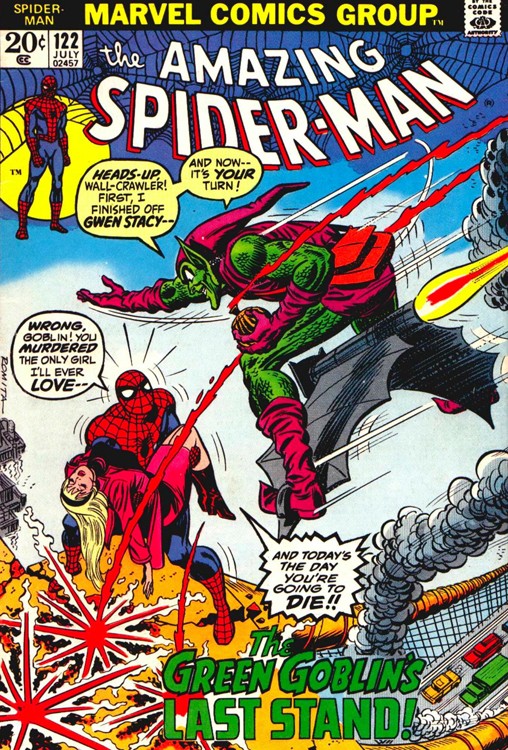
When I think back about the comics I read when I was very young I invariably remember getting them at the newsstand, but upon checking the street dates (thank you, internet), it turns out that some of those comics were published far before I was old enough to read. My next door neighbor and childhood best friend, Tommy Morley, also read comics and (like me) he had a small collection of back issues that were slightly too old for him to have picked up brand new, too. So, while I'm unsure of the precise circumstances surrounding it, it could have been forty years ago that The Amazing Spider-Man #122 found it's way into my life. It bore a street date of July 1973, but I couldn't have gotten around to reading it until at least August 1975 (the same month I received the first appearance of Moon Knight), so it was very likely 38 years ago this month that Gwen Stacy died in my own, personal continuity.

In this day and age where heroes, villains and supporting cast routinely die only to be resurrected a few years (or a few issues) later, it's easy to take the death of Gwen Stacy for granted. But back then it was a very big deal. I know from personal experience that there are a lot of guys in their mid forties who first learned about mortality via that comic. I had never known anyone who died at that point in my life, and I had a lot of questions for my parents about it. I had also never paid much attention to the creative teams that wrote, drew, inked or colored the comics I read up until then. I did, however, commit Gerry Conway's name to memory. Even at that young age I understood that it had been he, not Spider-Man or the Green Goblin, that killed Gwen Stacy.

It's perhaps fitting then, that August should also mark the occasion that The Death of Gwen Stacy should re-enter my life. While investigating a completely unrelated matter, I found myself on Ebay last week. A private collector had listed a large assortment of color guide proofs and digital production proof sheets and among them was one of the all-time best Amazing Spider-Man pages. Anyone who collects original comic book art knows that almost all of the key pages from the great comics have found their way into private collections and only ever re-enter the marketplace when a collector dies. It's impossible to look for specific pages because they're long gone. And if you inquire about a specific page you'll generally stir up more interest that will make it much harder for you (or at least much more expensive) should that page ever surface.

Page 5 of issue #122 of The Amazing Spider-Man is a half-splash that captures the grief of a superhero–powerless to prevent the death of a loved one and engulfed by guilt for his role in it. A montage of the supporting cast plays in his head as the narration pronounces the death of a main character. It's actually difficult not to get a little choked up by it now as I write this. John Romita and Gil Kane were true masters of the form and there are few pages more important in the history of the medium. This event signaled the end of the Silver Age of comics. The page (pictured at left) isn't the original pencil and ink artwork from 1973, but for less than ten percent of what the original comic book routinely fetches, I won the digital proof sheet created by Marvel and remastered from the original pages for their series of omnibus reprint collections. It features the digitally perfected black and white art on paper stock with a mylar overlay of the lettering.

High quality digital printing is relatively new, so this this type of production art is fairly recent, but already almost obsolete. Previously, bound editions were little more than newsprint collections with art shot directly from the published books. The old proof sheets were generally just xerox copies and they looked terrible, guaranteeing that nobody would collect them. Production art (including original hand-painted color proofs) has historically been overlooked by collectors and undervalued in the hobby, with much of it even being discarded by the editorial staff or art department after being approved for print.

These new, digital match-prints are a whole other thing. They often go back to the original art files or photographic records and painstakingly clean up the images to grant the greatest integrity to the original art work, which is often in pretty bad shape from poor storage before entering the collectibles market. The original film is often in the condition of public library microfiche: worn, possibly blurry and covered in scratches, so the effort that goes into the clean-up is often extraordinary because the match-prints are pristine and gorgeous. And most importantly for collectors, these production proofs, like the original hand-drawn pages, are unique: there is only one final proof. Publishers never hold onto this stuff, making it in many ways more rare than original pencils or blue-line sheets. Now, with production budgets even more limited than before, most digital remastering jobs are approved via pdf, so match-prints are rarely produced. That makes pieces like this one artifacts of era-specific comic history; they are an anecdote in the overall legend.

Just as digital is only now finding its footing alongside analog in the fine art world, many comic art collectors are just now becoming aware of these genuine treasures. In the last few years, pre-digital-era color proofs have skyrocketed in value with the realization that they are original paintings that just happen to have been rendered over photocopies of the original, inked art pages. With key moments from comic book history few and far between, these pieces provide a second bite at the apple for collectors who can't afford the tens of thousands (to hundreds of thousands) of dollars that original John Romita and Gil Kane pages inevitably command–especially from Gerry Conway's tenure as writer under editor Roy Thomas. The price gap between color proofs and pencil pages is rapidly narrowing, and so, in time, will the price gap between analog and unique digital production art. I have to imagine that the popularity of a digitally produced series like Saga will really move the needle in the demand and escalated pricing of digital proof pages. At least as long as such pages are produced, since Saga is definitely a product of the pdf approval era. Will today's readers feel in forty years as I do now about Spider-Man, Daredevil, Teen Titans or Watchmen? I hope so. 

As I remember now how the Death of Gwen Stacy affected me in my youth, there is a poignant mix of nostalgia for adolescent grief and pride of acquisition that reminds me why the true art of this medium is its unique blend of visuals and story. Comics are figurative and narrative art at the very nexus of their being. The two forms are indivisible and more satisfying for it.

'Nuff said.

Wednesday, July 24, 2013

One more Comicon Anecdote

On the Sunday before Comicon, we hosted Harlan Ellison for a book signing at La Luz de Jesus Gallery. I wasn't able to attend because I was extremely ill (and got my relapse immediately after Comicon), so I missed one of the few opportunities I'll ever have again to spend time with Harlan. When I went through the gallery of pictures taken by our publicist, Lee Joseph, I saw a sequence of images featuring Bill Sienkiewicz–compounding my disappointment at not being able to host the event in person.

The following Saturday at Comicon, I found Bill at his table. After catching up a bit and discussing some upcoming gallery business I relayed to him my apologies for not being at the Ellison signing, but told him I had a great couple of pics of him with Harlan. As we were about to part company, Brian Michael Bendis walked over and told Bill that they (and Klaus Jansen and my friend David Mack) had just topped the New York Times Best Seller List with the hard-bound, collected Daredevil: End of Days.

Bill re-introduced me to Bendis and said, "Well I guess you get to share in this victory, too!" which just about made my day.

Below are those two great pics of Bill with Harlan.


Monday, July 22, 2013

Get Cape Conscious–Join the Hero Inititative!

The 1986 shame campaign
Most comic collectors are familiar with the royalty battles that the creators of their favorite characters have had to fight against the megacorporations that now own DC and Marvel (not to mention EC, Fawcett, Gold Key, National, Timely and Atlas). If coverage of the recent Iron Man 3 or Man of Steel films seemed noticeably absent from this column it's because I was in an ethical dillemna regarding coverage of content directly related to this column and the recent court rulings that gave copyright of Superman to Warner Brothers over the estates of creators Jerry Siegel and Joe Shuster, and barred Jack Kirby's estate from any piece of future Marvel product. I knew that I was going to see these movies, and therefore calling for a boycott would have been hypocritical, so I decided to not further add to the publicity machine by reviewing them whilst they were still in theaters.

For the record, I really enjoyed Iron Man 3 and can't believe how implausible Man of Steel was.

Most comic fans are completely unaware, however, of the hardships faced by virtually all comics professionals in their later years. I can't call them retirement years because very few comic artists actually get to retire. Working as freelancers in an industry without a union has left very little in the way of a nest egg or retirement fund for most of the people that wrote, drew, inked, colored or lettered the best comics of the Golden, Silver, and Bronze Ages. When considering that most of those creators toiled for low page rates with no chance at ownership and no royalties while building a multi-billion-dollar industry, it's especially despicable. And even contemporary artists were likely to be uninsured until Obamacare went into legislation, which meant bankruptcy and premature death in the face of any serious medical issues. Natural disasters or any other unexpected expense can mean instant unemployment for them just as it can for the rest of us.

Pang-ju: created in Korea,
but manufactured in Japan
This past weekend at the annual San Diego Comic Con International, I made it a point to avoid the big entertainment company booths completely. It was my wife's first Comicon experience and she had a blast weaving through the artist alley tables and the small press aisles, and discovering the latest toys from her native Japan to make a splash here in the USA (Pullip and Pang-ju especially). We embraced the bump-into factor inherent in an event of this size, and enjoyed seeing friends from all walks of life (and parts of the world) as we navigated the convention room floor. We checked out panels for my friend Huston Huddleston's Star Trek Bridge Restoration project and Ryan Ridley's new gig writing Rick and Morty for Adult Swim. Most of the art reps whose collections of amazing original comic art helped me to launch Pop Sequentialism are all gathered in the same area, and this year I was happy to see the Hero Initiative's booth among them.

The Hero Initiative is the first ever federally chartered not-for-profit organization dedicated to helping comic book veterans. Through Hero Initiative, financial aid is available for comic creators who may need assistance with the necessities of life or simply a helping hand back into the comics industry. It's a chance to give back to the people who have given us so much enjoyment. The fund disbursement committee includes Hall of Fame creators Howard Chaykin, Denny O'Neil, John Romita, Sr., Walt Simonson, Roy Thomas, Jim Valentino, and George Perez–who drew me this awesome Robin portrait. The suggested donation for sketches was $40.00, but I tossed a Franklin in the bowl to guilt the crowd around me into giving more than just the minimum for such a worthy cause. George has done well and given back to those less fortunate. He's gregarious and still enthusiastic about comics, fans, & life in general, and his run on New Teen Titans has much to do with Robin / Nightwing being my favorite character of all time. He called me a "Graysonite" with a smile and I nodded proudly.

Monday, July 15, 2013

Wolverine on the New York Times Best Seller List?

In a brilliant marketing move anticipating the release of the new Hugh Jackman movie that hits theaters at the end of this month, Marvel has collected Mark Millar's run on Wolverine into an Omnibus. This 576 page deluxe edition contains Wolverine 20-32, 66-72, and the Giant-Size Old Man Logan special–and it currently ranks fifth on the New York Times Best Sellers list of Hardcover Graphic Books.

The first half is the "Enemy of the State" story-line illustrated by Millar's Kick-Ass colleague John Romita Jr. which pits a rabid and brain-washed Wolverine against the entire Marvel Universe. It was a blood-thirsty romp, considered the ultimate Wolverine tale by fans. After a four-year absence from the title, Millar returned with a post-apocalyptic vision of tragic pathos that followed an elderly, retired, and pacifistic Wolverine, and it doesn’t get any better than this. Millar’s Civil War penciler Steve McNiven enhanced his usual adrenaline-rush theatrics with a rougher edge that captures archetypal Clint Eastwood at his wild-western best via Mad Max.

WOLVERINE: OLD MAN LOGAN (2010)
by Mark Millar & Steve McNiven
Issue #71, Cover Rough (gore cover)
Graphite on paper
Signed by Steve McNiven
8.5" x 11"
$2,000.00


Foreign orders please add an additional $20 for postage.

The page above is a cover study for issue #71; the rough, pencil outline of the cover that would eventually be published. An extreme close-up of the titular hero’s face (with bullet wounds exposing the adamantium skull beneath his flesh before his mutant healing factor can repair the damage) reveals the quiet rage that has long been building in Old Man Logan, who long ago vowed to sheath his mighty claws. It’s one of the goriest superhero comic covers ever, and it epitomizes the best of Millar and McNiven’s work together: tough, gritty and barely containing the violence that percolates just beneath the surface. The team that shattered the status quo with the mega-hit Civil War reunited to tell the greatest Wolverine tale of them all –a sort of Unforgiven meets Dark Knight. This page was included in the Pop Sequentialism exhibition and the accompanying published catalog.

Wolverine has been a fan favorite ever since his introduction in the Incredible Hulk back in 1974, but it was the Frank Miller mini-series by Uncanny X-Men scribe Chris Claremont that established the character as a genuine, marquee name. And ever since Frank Miller's back-to-back prestige format books Ronin and Batman: The Dark Knight Returns, fanboys have been praying that he would do a retirement age tale of the most savage mutant in all of comicdom. As the years stretched on and Miller's output became more erratic and less satisfying, Mark Millar became the go-to guy for well-written machismo.

Mark Millar has been one of the key figures of 21st century comics. Following a series of well-received collaborations with fellow Scotsman Grant Morrison at DC, Millar went solo in 2000 replacing powerhouse writer Warren Ellis on Wildstorm’s hit series The Authority. His controversial, over-the-top approach to the already dynamic superhero action garnered a heap of awards in the UK and America, but caused a bit of friction with publisher DC and Warner Bros, who greatly censored his scripts in an era of post 9/11 sensitivity. This led to his departure from DC, and offers of lucrative work at Marvel. In 2001, following the success of Brian Michael BendisUltimate Spider-Man, he launched Ultimate X-Men. It was huge. The following year he rebooted The Avengers via the title The Ultimates, which proved more popular than the X-Men. It became something of a phenomenon and the brass at Marvel’s film division used it as the source template for no less than four films, including Iron Man, Thor, Captain America, and The Avengers. He’s also had two big-budget, big-screen blockbusters adapted from his creator-owned titles Wanted and Kick-Ass–with a Kick-Ass sequel set for release next month.


So congrats to Mark Millar, John Romita Jr., and Steve McNiven for their continued success with a classic tale from the modern age. And congrats also to Darwyn Cooke and Amanda Conner who nabbed the New York Times Best Seller list's top spot with their Before Watchmen: Minutemen / Silk Spectre split hardcover collection, which represents the best of an otherwise mixed endeavor in telling new stories with characters created by Alan Moore and Dave Gibbons*. Cooke's New Frontier treatment of the Watchmen's under-represented characters is classy, reverent and enriching, while Conner's decidedly female perspective was fresh, light and endearing.

*scroll back through this blog for my take on the entire Before Watchmen line.

Saturday, May 25, 2013

Why Do Critics Suck?

Leonard Schader
When I was a slightly younger man, Leonard Schrader was a friend of mine. We didn't hang out and smoke cigars, or go bowling or buy each other lunch, but we were most definitely friendly and conversed a lot. While most people are undoubtedly familiar with his brother Paul's cinematic resumé (writing Taxi Driver and Raging Bull, directing American Gigolo and Cat People), Leonard's contributions include co-developing the films The Yakuza, and Mishima: A Life in Four Chapters, as well as adapting the Oscar-nominated screenplay for Kiss of the Spider Woman. I met Lenny when I worked at Hollywood Book and Poster, and our conversations spanned many subjects as I sold him classic lobby cards and screenplay reprints from the shop's massive archive (which he would implement in his screenwriting classes at AFI, Chapman and USC). Despite the massive age difference, we had a few things in common: we were both married to Japanese women, shared an affection for wolves and wolf-like dogs, and were more fond of silent comedies than contemporary ones. He was a friendly unassuming guy with a lot of knowledge and I learned a lot from him.

I was a fan of his writing and having noticed the long periods of absence between produced projects in his IMDB credits, asked him why his output was so minimal. He told me that the artistic freedom of the 1970s had become a corporate nightmare in the 1980s when, as a rewrite scribe, he would commonly get notes from executives to "dumb down" the material. The studio bosses at this time weren't filmmakers like the generation that preceded them. They were financiers: junk bondsmen appointed by stockholders who would just as soon invest in fudge as in film. In Leonard's estimation, these guys had about as much entitlement to critique writing as a cat had a need for pajamas. His interest in taking thankless writing assignments waned as his original pitches were routinely turned down. In actuality, he had remained quite busy though his resumé didn't reflect it. Many writers wind up pounding out numerous transitional drafts in the nebulous grey area between script inception and filmed realization. Most folks not glued to the trades just aren't aware of how much time is spent on projects that change direction, swap genre midstream or go nowhere. Development can swallow a decade or more of a writer, director, or producer's time as studios greenlight and cancel projects without shooting a single scene–with the biggest casualty often being originality.

Don Simpson, Jerry Bruckheimer & Michael Bay
The cocaine fueled 1980s were certainly no high water mark for intelligent decisions, and major big-budget misfires helped to limit the freedom allotted to the auteurs that changed cinema in the 1970s. The decline of the mavericks coincided with the birth of the event film, and the summer blockbuster became the goal of literally every major studio in Hollywood. Over time, the heightened craft, dazzling special effects and compelling stories that made the early blockbusters successful (Jaws, Star Wars, Raiders of the Lost Ark) were simplified into a formula that consisted only of special effects and marquee names, so that star-driven vehicles, sequels and remakes out-trumped the tried-and-true equation of good story + good acting = hit.

I'm not telling you anything new here. You've seen it in Easy Riders and Raging Bulls and the chronological follow-up, The Blockbuster Imperative. What drives me crazy is that so few of the theater-going public have learned anything from those films or from their own movie-hopping experience.

Eligible in 16 award categories, nominated for 1, winner of 0

Cloud Atlas was released on DVD and BluRay last week. It was a hundred million dollar, independently financed film faithfully adapted from a critically acclaimed novel featuring a cast of household names, directed by billionaire franchise creators and an arthouse god. It was an incredibly original story that tackled complicated themes in an entertaining way via powerhouse performances and stunning special effects and, of course, it flopped miserably. Apparently, the public has become accustomed to "dumbed-down" entertainment, because this was a thinking man's sci-fi adventure and audiences avoided it like the plague.

Roger Ebert
Many critics had at least a few nice things to say about the movie, but seemed more interested in predicting failure than championing quality. The first three reviews I read, which were quite lengthy, seemed completely incapable of describing the plot and left very little indication of whether they liked it or not. As with far too many syndicated review columns, the ego of the writer and the need to use interesting and uncommon verbiage trumped the actual purpose of the review: to make a case either for or against the film based on what is on screen. Instead, confused readers were treated to nit-picky non-specifics by armchair directors flexing their thesauruses in a series of paid-by-the-syllable word mills. The same critics that champion every single befuddling film from David Lynch or Werner Herzog were (incredibly) incapable of comprehending a fairly straight-forward and universal tale of the thirst for freedom, the value of integrity and the immortality of love. If only a real critic like Pauline Kael had been around to champion Cloud Atlas, it might have gained traction and then word of mouth. Even Roger Ebert (who gave the film a four star review) tap-danced around the plot and injected enough doubt in the first paragraphs of his review that it basically ensured on-the-fence film fans would skip it. What a disservice!

Of course the lack of studio support should become a case study in movie marketing failure for decades to come. Warner Brothers dropped the ball on this like they did with Iron Giant, My Dog Skip and A Little Princess. Because of the massive box office failure, Cloud Atlas has all the earmarks of becoming a legitimate cult classic, but the film's poor performance virtually insures that nobody will ever take a chance like this again. That is a pox on all of our houses, and all of you who didn't go see it on the big screen are to blame. Shame on you. It's because of you that we'll all be served Paranormal Activity Part Fuck You until the end of time. Thank you also for guaranteeing sequels to Silent Hill and Resident Evil and every other shitty video game adaptation that comes down the pike until the dead actually do rise and kill us all.

So... yes, this is a bit of an I Told You So. You screwed up by not supporting visionary filmmakers in a grand experiment, but you've got the chance to make up for it by buying the DVD, Bluray or Ultraviolet download. Add the film to your Netflix cue and request it on Red Box. When you finally do see it (and love it) post about it on facebook, twitter, instagram, tumblr, and in your blog. Cloud Atlas finally will get it's due, but please do me a favor: don't claim that you saw it on the big screen because I saved my ticket stubs and I will absolutely call bullshit on you.