Tuesday, March 18, 2014

What Do Artists Do All Day - Frank Quitely

The BBC Four recently profiled Frank Quitely as part of the their What Do Artists Do All Day? series. Fans who enjoy Quitely's art on Jupiter's Legacy and All Star Superman are in for a real treat as he runs down his creative process in a programme that runs nearly half an hour and focuses heavily on those two books, WE3 and a Walking Dead cover. Critical fans nonplussed by the artist's frequently late delivery may be in for a change of heart as Frank is revealed to be a very thoughtful plotter who spends far more time on the page design than on the actual drawing. More often than not it's what doesn't end up on a Frank Quitely page that makes the difference.


Integration of digital and analog sketching is becoming far more common now in the printed medium, but the degree to which individual artists incorporate the two is fascinating. Quitely starts with dozens of thumbnail sketches in notebooks before moving to digital page layout and digital blue-line sketching. When no higher degree of digital detail is possible, he prints out his blue-line and details in pencil on paper. This is comparable to the penciler/inker relationship of days gone by, which means that Frank is generally spending twice as much time on his illustrating process as his peers.

But before Quitely presses pencil to paper, he frequently reads and re-rereads a script before making notes about how to illustrate it. This elongated think time is probably the single thing that most sets him apart from the competition. Quitely really digests the story and make sure he's completely understanding the plot, actions and subtleties of character to the point that he can see it all clearly. This dedication to the writing on the part of the artist is what makes him one of the highest demand pencilers in the business.

It's also nice to learn that Katsuhiro Otomo has had such a big impact on Frank's work. While less obvious than the influence of Moebius upon Geoff Darrow, it is never-the-less surprising that I didn't pick up on it until now.


All Star Superman #9, page 3

Batman and Robin #3, page 20

Batman and Robin #3, page 1

New X-Men #114, page 23


Frank Quitely is the artist most represented in the published Pop Sequententialism catalog, with one page from All Star Superman, two pages from Batman and Robin, and a New X-Men splash–all printed as they appear pre-production. It's no secret that he's one of my favorite artists, and it's good to know that while video game and storyboard assignments frequently beckon with better pay, Quitely genuinely prefers doing comics which allow him a far greater creative freedom.

Besides, pensive pacing doesn't lend itself to the rapid-demand turnaround of continuity design.

Thursday, February 13, 2014

The Coming Comic Book Strike

Earlier this week, Multiversity Comics' David Harper wrote an excellent column about Comics and the Diminishing Role of Artists in a Visual Medium. It's been making the rounds on social media as many artists have been sharing it in a rare example of solidarity. I immediately wrote to David to praise him, and put forth a little theory of my own about exactly when this power shift (form artist to writer) took place. I've been criticizing it vocally for years, and it's in-house continuity.

Publishers like Marvel and DC have been relying on company-wide story lines which are heavily dependent on continuity. That places the greatest responsibility in the hands of the story architects. People like Brian Michael Bendis and Geoff Johns have been given the reigns of not just one or two characters but entire universes. This blocks the use of any character involved in even a limited capacity, which disallows their use for the type of incredible reboots that marked the Vertigo boom of the late 80s and early 90s. Imagine a comic book world without Neil Gaiman, Grant Morrison, or Peter Milligan if Marv Wolfman had the power back then at DC that Bendis now has at Marvel. What if he chose to veto new writers from using throwaway characters like Sandman, Animal Man, Doom Patrol and Shade the Changing Man because he might have had plans to include them in company-wide crossover. Marv isn't the type of guy who would have blocked new creators, but his Crisis on Infinite Earths did force a curmudgeonly Alan Moore to begrudgingly include Martian Manhunter and Batman into a Swamp Thing story to fit the company-wide continuity. 

The power of the few crossover architects prevents new writers from breaking into the business. It also either alienates casual fans or requires them to bulk up on their monthly purchases (even though they may only be interested in one or two titles) because the massive-multi-book tie-ins place favorite characters in other books in which important events may (but usually don't) take place. This eventually leads to fan drop-off.

Company-wide crossovers were the beginning of the end of artist power. The double shipping that David Harper mentions in his article was the nail in the coffin.

Of course, many artists were their own worst enemies. The Multiversity blog mentioned the notoriously late Frank Quitely and John Cassaday, who really are the last two superstar artists in the comic book biz. Before fans cry Adam Hughes, it's important to remember that he is much better known for his covers than interior work, and therefore less likely to be in a position to hold up the publishing schedule. The business requires consistent ship dates, and artists who can't deliver on time will become marginalized. Remember that it took the better part of five years for three issues of Neal Adams' Ms. Mystic to see the light of day, and he had a whole stable of artists at his Continuity Graphics. In the end, this is an editorial problem. Editors are on the front lines with artists and know how many pages these guys can do in a month. If the artists got a head-start of half-a-year before street date on the first issue, Astonishing X-Men and All Star Superman probably still would've been late. OK. Bad example. Nothing can get those two to deliver on time, the knowing of which should instill a healthier respect for the great artists of the 70s like John Byrne, George Perez and Gene Colan who routinely worked on multiple titles that were 32 pages or more each month. And these were no mere journeymen. They produced top notch work on a regular basis. If they'd had the luxury of time that today's artists have, I can't even imagine how beautiful the finished art would've been–as long as Vince Colletta didn't ink it.

Harper referenced the work of Charlie Adlard and Ryan Ottley (ironically on titles both written by Robert Kirkman) as examples of consistent and long running series that have relied on just one artist. These guys have the luxury of working on one title because they are co-creators and are getting royalties based on that. Most "house" and freelance artists (not co-creators or superstars) aren't getting any royalties regardless of how many issues of a particular issue sell. The numbers may be up from where they were last year, but compared to the early Image launch numbers, most books are at 10% of where they were in the pre-videogame, early 90s. The long runs of Salvador Larocca on Iron Man and Mark Bagley's record-breaking, uninterrupted run on Ultimate Spiderman are flukes that have a lot to do with their relationships with the superstar writers they teamed with. Bendis clearly had Bagley's back. I don't know if it was out of superstition or camaraderie, but I don't think Bagley was making a lot of money, and therefore wasn't a liability to the company. I confess total ignorance on this matter of pay, and mean no disrespect one way or the other. Even if Bagley was getting $500 per page, considering the sales on that title, he was grossly underpaid–and such rates would put him in the top 1% of comic artist salaries.

A good friend of mine whose covers were recycled by Marvel for bound collections of the series they worked on didn't even get paid for the reuse of their art on these additional editions, each of which had high circulation. The art was also recycled for in-house ads for which no payment was made. I think they got $600 per cover. When DC launched a new indie line they offered this same artist even less for covers, even though the approach started on DC's end. This was at the same time that our mutual friend Dave Johnson was getting a couple thousand dollars for his covers to 100 Bullets and then selling the original art for between seven and ten thousand dollars each. But digital artists have no original art to sell, which is how comic artists in the past had been able to subsidize their shitty income. It's disgraceful, but it's nothing new. I haven't seen many Dave Johnson covers since 100 Bullets came to an end, and it wouldn't surprise me to find out that current cover rates preclude that possibility now.

Bob Layton, who should be getting some serious Iron Man movie money right now, probably isn't. He's completely left comics for Hollywood, choosing project development over slave wages. Who could blame him? The aforementioned Gene Colan died in poverty and it was the Hero Initiative that paid the medical bills that kept him alive for his last couple of years, not residuals from Marvel for the many titles he created or contributed to. Marv Wolfman and George Perez are a couple of the very few creators from the 70s who've managed to do really well for properties that they created, and probably only because timing was on their side. New Teen Titans was the first Baxter edition book and the circulation numbers in the 80s were huge. DC cut them a reasonable deal and when the animated series took off years later, they were sitting pretty. Marv makes his living writing animated series instead of comic books these days, which means he gets Screen Writers Guild money instead of the non-union, funny-book shaft. George still gets his royalty checks but the only new income he's generating comes from working on comics from the big two. I don't know how much he gets paid but I really hope it's more than the flat rate.


The only viable future in the comics business for artists is in creating and self-publishing, unless they all wise up and unionize. The problem with organizing a union, is that it would require cooperation from the writers and most of them are already signed to lucrative (sometimes lifetime) contracts. I doubt very much they'll rock the boat. Since most artists live below the poverty line, they're already living hand-to-mouth and it's difficult to ask someone to risk losing that for a greater good. This isn't the 1940s or 50s and union busting is business as usual now.

Of course, on the flip side, when you're standing on the bottom rung, the fall won't kill you. It's the rush of new legs that trample you on their way up to the bottom rung that does the damage. As long as new artists are willing to be mistreated it will never get better. There is virtually no solidarity among artists who often refuse to talk rates out of pride or embarrassment or both.

Writers have more power because they can be working on far more projects at the same time and capitalize on a success almost immediately, whereas an artist has to labor over work that a writer may have finished a year ago or more. It's much more likely that a writer will have multiple titles on the stands at the same time, which raises their stock among fans and accountants. In instances where writers really are writing more than one series at a time (rather than benefiting from the prolonged publishing schedule), the quality of the writing is often diluted over all titles. Few writers have been able to do their best work on multiple titles at the same time, because their attention is shifted. I can see how this would make crossovers very attractive to the industrious writer, though, as they can remain focused on the big picture while drifting focus across multiple characters and reassigning the writing chores for characters they don't have a head for. Some writers have had greater success than others in this endeavor, but with pay as it is, you can't blame them for picking up as many titles as possible. Fans are very forgiving, and opportunity is rare.


At least the powers-that-be are recognizing that new ideas and creativity have a currency that can't be reduced to formula if success is the goal. That has lifted writers from the canyon, but that doesn't mean that artists have to dive into the canyon in their place. If they stand their ground, they'll eventually rise, too. An industry-wide strike would cripple DC and Marvel. There is no way they're going to turn to their entertainment divisions to bail them out, ether, because those employees make real money. Perhaps the solution isn't for comic artists to start their own union, but to join an existing one. That would be a much more feasible scenario and the benefits (literal and figurative) would be incredible. Under current Writer's Guild definitions, most comic book artists as 50% contributors to the story would qualify for membership. And getting those definitions altered and more inclusive is a fight worth launching, as long as there exists a clear and certain path for new writers and artists to enter the business.

The irony of course, is that after a strike ended, the press and excitement wouldn't just reclaim the drop-off in casual readership, it would probably expand it exponentially because the reputation of the unions behind the workers would send a message that the quality is now somehow higher.

Now you know what to do, comic creators. Go forth in rage and return in prosperity.

STRIKE!

*I want to be clear that I am in no way criticizing Brian Michael Bendis or Geoff Johns who have worked incredibly hard and written thousands of pages of the best work in the medium to get to their current positions of power. More power to them. It's the system and the power structure with which I take issue.

Monday, February 10, 2014

Clive Barker NEEDS Your Help

Clive Barker is without doubt an Imaginer. His work as a writer has been universally praised across multiple genres, be it dark, adult fantasy or children's literature. His work as a filmaker in the horror arena has garnered millions of fans worldwide. Yet, while the hardcore Fifth Dominion fanbase has been aware of his painting talent for years, much of the rest of the world are less acquainted with the thousands of original works he has produced via pen or paint or camera for fine art galleries, private collectors and museums.

Today is the last day of the Clive Barker kickstarter.

Century Guild director Tom Negovan has assembled an amazing creative team to archive and edit the massive collection of the artist's works to produce a broadly encompassing volume. It will be limited edition, immaculately packaged and required a tremendous amount of hours and labor. The gifts you'll get for pledging are extraordinary, and as of this writing there are plenty of incentives still available. I would be remiss if I didn't state that Barker's health invites speculation about how much more work he'll be able to produce in this lifetime. I don't claim to have more information than anyone else, but I highly recommend that you appreciate the man while he is still with us, and contributing to this kickstarter campaign offers just such an opportunity.

Clive Barker has been an incredibly important contributor to the comics medium, and that alone would warrant coverage in this column, but it is with no minor pride that I report to have been party to one of the first American exhibitions of his work over fifteen years ago at La Luz de Jesus Gallery.  I've met him on several occasions and found him to be kind, articulate and encouraging not only to his friends and fans but also to his detractors.

Below is a video explaining the perks of support. You can get cool swag for as little as $14.


I didn't realize until today that this column has become a quarterly concern, rather than a bi-weekly blog. I'll be rectifying that for sure, and hope you stay tuned.

Wednesday, October 16, 2013

The Best of Milligan & McCarthy

Required Reading!
  On September 11th, Dark Horse Books released the long awaited collection of classic collaborations from the creative team of Peter Milligan and Brendan McCarthy. Branded THE BEST OF MILLIGAN & MCCARTHY, and produced under the Dark Horse Originals imprint for great creators and original visions, this omnibus remasters stories that stretch back as far as 1978's The Electric Hoax comic strip from UK music paper Sounds. This deluxe hardcover contains the complete Paradax, Rogan Gosh, and Strange Days–including not just Freakwave, but all the interstitial strips and Eclipse titles that predate Vertigo like Mirkin the Mystic and the supplements to the Paradax Remix. One of the most indisputably unnerving sequential tales of all time, Skin, is here complete as well. So are Summer of Love and Sooner or Later, which have been whispered rumors to most American comics enthusiasts until now. At only $24.95 it's quite a bargain, too.

The really wonderful thing about this collection is the succession of reminiscences that precedes each story, which helps to give context to the content. Without it, the sheer importance of the work might be lost on the masses. This was groundbreaking stuff, and actually would still be groundbreaking if it were all brand new. Most of the work produced in American comics in the late 1990s and forward owes a great debt to the work of these two Brits, whose bravery was seldom rewarded as much as those who followed. Milligan & McCarthy weren't just contemporaries of Alan Moore, Neil Gaiman and Grant Morrison, they were influencers.

Not for sale, so don't even ask!
Included, perhaps, as a preview of an omnibus to come, are several covers and interior pages from their Shade, The Changing Man reboot, too. Long overlooked, this was an engrossing, dramatic series that delivered on every level in issue after issue as it got less and less commercial, losing many an award to the predominantly anthologized Sandman. And the page with which they chose to end this tome just happens to be the color version of the page I've had in my own collection since April 1992.  It is the page that–more than any other, inspired the Pop Sequentialism exhibition and catalog, and therefore this very blog. The grounded surrealism of Brendan's illustrations and the deep melancholy of Pete's words embodied pop in the new context of narrative art. As a lifelong collector of original comic art, I've at one time or another owned multiple Jack Kirby, Neil Adams, Simon Bisley, and Todd McFarlane pages that I had to let go for one reason or another, but I kept my Shade page. 


I am greatly honored to be included in this omnibus, as Brendan saw fit to run a quote from me on the back cover, alongside incredibly important people like Gorillaz & Tank Girl creator Jamie Hewlett, Vertigo Editor Karen Berger, and Marvel editor in chief Alex Alonso. I have been lucky enough to meet my idols on a handful of occasions, and by some miracle of fate I now call some of them colleagues and some of them friends. I am humbled by Brendan's friendship and proud to have presented his work in a gallery setting more than once. Both of the men presented in this book are a credit to the industry they choose as their own, and both continue to produce mature, relevant work that defies classification even within their genre assignments. So don't be surprised if THE BEST OF MILLIGAN & MCCARTHY turns out to be only Volume One...


Wednesday, August 14, 2013

The Death of Gwen Stacy (a Personal Continuity)

Like a lot of kids who grew up in the 70s, I read comics. Quite often I had no idea from where they had come or how I came to possess them, but they always seemed to be there. Being the youngest of six, a lot of them were hand-me-downs. I honestly can't picture any of my sisters reading The Incredible Hulk, Werewolf by Night, or Giant-Size Man-Thing, however, so I must have pestered my mom to buy them for me in the checkout line at Stop & Shop or via the mysterious grab bags that local grocer Merty Bligh put together. 

Those grab bags were a very mixed bag indeed. They generally featured two Marvel or DC comics, an odd Charlton and Gold Key title, and inevitably the dreaded Harvey publication. The cost? Thirty-five cents or three grab bags for a dollar. They were the predecessor of the modern blind-box, and came wrapped in nondescript brown paper. There was no continuity in these bundles, so following a specific title was near impossible. Such infuriating, uncontrollable randomness lead me to appreciate anthologies and stand alone titles like DC's House of Mystery, or Marvel's Team-Up books. Once, when the cashier at Bligh's gave me back too much change for a gallon of milk and a loaf of bread, I was given an 80 Page Giant as a reward for returning the money. Life changing moment, right there.

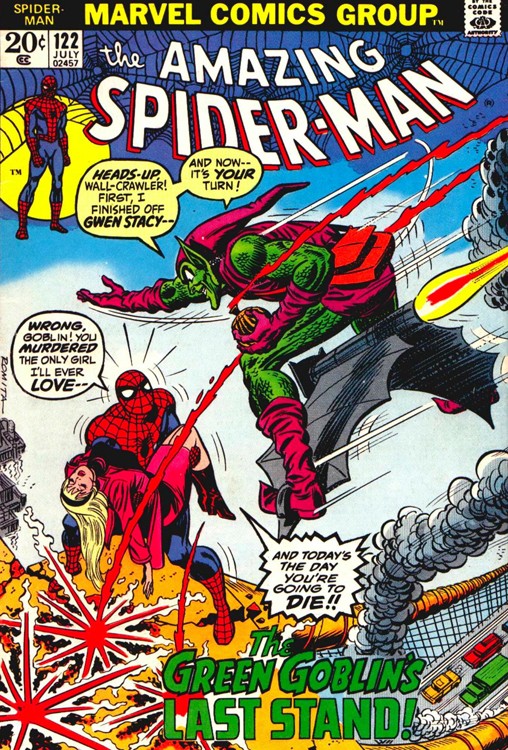
When I think back about the comics I read when I was very young I invariably remember getting them at the newsstand, but upon checking the street dates (thank you, internet), it turns out that some of those comics were published far before I was old enough to read. My next door neighbor and childhood best friend, Tommy Morley, also read comics and (like me) he had a small collection of back issues that were slightly too old for him to have picked up brand new, too. So, while I'm unsure of the precise circumstances surrounding it, it could have been forty years ago that The Amazing Spider-Man #122 found it's way into my life. It bore a street date of July 1973, but I couldn't have gotten around to reading it until at least August 1975 (the same month I received the first appearance of Moon Knight), so it was very likely 38 years ago this month that Gwen Stacy died in my own, personal continuity.

In this day and age where heroes, villains and supporting cast routinely die only to be resurrected a few years (or a few issues) later, it's easy to take the death of Gwen Stacy for granted. But back then it was a very big deal. I know from personal experience that there are a lot of guys in their mid forties who first learned about mortality via that comic. I had never known anyone who died at that point in my life, and I had a lot of questions for my parents about it. I had also never paid much attention to the creative teams that wrote, drew, inked or colored the comics I read up until then. I did, however, commit Gerry Conway's name to memory. Even at that young age I understood that it had been he, not Spider-Man or the Green Goblin, that killed Gwen Stacy.

It's perhaps fitting then, that August should also mark the occasion that The Death of Gwen Stacy should re-enter my life. While investigating a completely unrelated matter, I found myself on Ebay last week. A private collector had listed a large assortment of color guide proofs and digital production proof sheets and among them was one of the all-time best Amazing Spider-Man pages. Anyone who collects original comic book art knows that almost all of the key pages from the great comics have found their way into private collections and only ever re-enter the marketplace when a collector dies. It's impossible to look for specific pages because they're long gone. And if you inquire about a specific page you'll generally stir up more interest that will make it much harder for you (or at least much more expensive) should that page ever surface.

Page 5 of issue #122 of The Amazing Spider-Man is a half-splash that captures the grief of a superhero–powerless to prevent the death of a loved one and engulfed by guilt for his role in it. A montage of the supporting cast plays in his head as the narration pronounces the death of a main character. It's actually difficult not to get a little choked up by it now as I write this. John Romita and Gil Kane were true masters of the form and there are few pages more important in the history of the medium. This event signaled the end of the Silver Age of comics. The page (pictured at left) isn't the original pencil and ink artwork from 1973, but for less than ten percent of what the original comic book routinely fetches, I won the digital proof sheet created by Marvel and remastered from the original pages for their series of omnibus reprint collections. It features the digitally perfected black and white art on paper stock with a mylar overlay of the lettering.

High quality digital printing is relatively new, so this this type of production art is fairly recent, but already almost obsolete. Previously, bound editions were little more than newsprint collections with art shot directly from the published books. The old proof sheets were generally just xerox copies and they looked terrible, guaranteeing that nobody would collect them. Production art (including original hand-painted color proofs) has historically been overlooked by collectors and undervalued in the hobby, with much of it even being discarded by the editorial staff or art department after being approved for print.

These new, digital match-prints are a whole other thing. They often go back to the original art files or photographic records and painstakingly clean up the images to grant the greatest integrity to the original art work, which is often in pretty bad shape from poor storage before entering the collectibles market. The original film is often in the condition of public library microfiche: worn, possibly blurry and covered in scratches, so the effort that goes into the clean-up is often extraordinary because the match-prints are pristine and gorgeous. And most importantly for collectors, these production proofs, like the original hand-drawn pages, are unique: there is only one final proof. Publishers never hold onto this stuff, making it in many ways more rare than original pencils or blue-line sheets. Now, with production budgets even more limited than before, most digital remastering jobs are approved via pdf, so match-prints are rarely produced. That makes pieces like this one artifacts of era-specific comic history; they are an anecdote in the overall legend.

Just as digital is only now finding its footing alongside analog in the fine art world, many comic art collectors are just now becoming aware of these genuine treasures. In the last few years, pre-digital-era color proofs have skyrocketed in value with the realization that they are original paintings that just happen to have been rendered over photocopies of the original, inked art pages. With key moments from comic book history few and far between, these pieces provide a second bite at the apple for collectors who can't afford the tens of thousands (to hundreds of thousands) of dollars that original John Romita and Gil Kane pages inevitably command–especially from Gerry Conway's tenure as writer under editor Roy Thomas. The price gap between color proofs and pencil pages is rapidly narrowing, and so, in time, will the price gap between analog and unique digital production art. I have to imagine that the popularity of a digitally produced series like Saga will really move the needle in the demand and escalated pricing of digital proof pages. At least as long as such pages are produced, since Saga is definitely a product of the pdf approval era. Will today's readers feel in forty years as I do now about Spider-Man, Daredevil, Teen Titans or Watchmen? I hope so. 

As I remember now how the Death of Gwen Stacy affected me in my youth, there is a poignant mix of nostalgia for adolescent grief and pride of acquisition that reminds me why the true art of this medium is its unique blend of visuals and story. Comics are figurative and narrative art at the very nexus of their being. The two forms are indivisible and more satisfying for it.

'Nuff said.

Wednesday, July 24, 2013

One more Comicon Anecdote

On the Sunday before Comicon, we hosted Harlan Ellison for a book signing at La Luz de Jesus Gallery. I wasn't able to attend because I was extremely ill (and got my relapse immediately after Comicon), so I missed one of the few opportunities I'll ever have again to spend time with Harlan. When I went through the gallery of pictures taken by our publicist, Lee Joseph, I saw a sequence of images featuring Bill Sienkiewicz–compounding my disappointment at not being able to host the event in person.

The following Saturday at Comicon, I found Bill at his table. After catching up a bit and discussing some upcoming gallery business I relayed to him my apologies for not being at the Ellison signing, but told him I had a great couple of pics of him with Harlan. As we were about to part company, Brian Michael Bendis walked over and told Bill that they (and Klaus Jansen and my friend David Mack) had just topped the New York Times Best Seller List with the hard-bound, collected Daredevil: End of Days.

Bill re-introduced me to Bendis and said, "Well I guess you get to share in this victory, too!" which just about made my day.

Below are those two great pics of Bill with Harlan.


Monday, July 22, 2013

Get Cape Conscious–Join the Hero Inititative!

The 1986 shame campaign
Most comic collectors are familiar with the royalty battles that the creators of their favorite characters have had to fight against the megacorporations that now own DC and Marvel (not to mention EC, Fawcett, Gold Key, National, Timely and Atlas). If coverage of the recent Iron Man 3 or Man of Steel films seemed noticeably absent from this column it's because I was in an ethical dillemna regarding coverage of content directly related to this column and the recent court rulings that gave copyright of Superman to Warner Brothers over the estates of creators Jerry Siegel and Joe Shuster, and barred Jack Kirby's estate from any piece of future Marvel product. I knew that I was going to see these movies, and therefore calling for a boycott would have been hypocritical, so I decided to not further add to the publicity machine by reviewing them whilst they were still in theaters.

For the record, I really enjoyed Iron Man 3 and can't believe how implausible Man of Steel was.

Most comic fans are completely unaware, however, of the hardships faced by virtually all comics professionals in their later years. I can't call them retirement years because very few comic artists actually get to retire. Working as freelancers in an industry without a union has left very little in the way of a nest egg or retirement fund for most of the people that wrote, drew, inked, colored or lettered the best comics of the Golden, Silver, and Bronze Ages. When considering that most of those creators toiled for low page rates with no chance at ownership and no royalties while building a multi-billion-dollar industry, it's especially despicable. And even contemporary artists were likely to be uninsured until Obamacare went into legislation, which meant bankruptcy and premature death in the face of any serious medical issues. Natural disasters or any other unexpected expense can mean instant unemployment for them just as it can for the rest of us.

Pang-ju: created in Korea,
but manufactured in Japan
This past weekend at the annual San Diego Comic Con International, I made it a point to avoid the big entertainment company booths completely. It was my wife's first Comicon experience and she had a blast weaving through the artist alley tables and the small press aisles, and discovering the latest toys from her native Japan to make a splash here in the USA (Pullip and Pang-ju especially). We embraced the bump-into factor inherent in an event of this size, and enjoyed seeing friends from all walks of life (and parts of the world) as we navigated the convention room floor. We checked out panels for my friend Huston Huddleston's Star Trek Bridge Restoration project and Ryan Ridley's new gig writing Rick and Morty for Adult Swim. Most of the art reps whose collections of amazing original comic art helped me to launch Pop Sequentialism are all gathered in the same area, and this year I was happy to see the Hero Initiative's booth among them.

The Hero Initiative is the first ever federally chartered not-for-profit organization dedicated to helping comic book veterans. Through Hero Initiative, financial aid is available for comic creators who may need assistance with the necessities of life or simply a helping hand back into the comics industry. It's a chance to give back to the people who have given us so much enjoyment. The fund disbursement committee includes Hall of Fame creators Howard Chaykin, Denny O'Neil, John Romita, Sr., Walt Simonson, Roy Thomas, Jim Valentino, and George Perez–who drew me this awesome Robin portrait. The suggested donation for sketches was $40.00, but I tossed a Franklin in the bowl to guilt the crowd around me into giving more than just the minimum for such a worthy cause. George has done well and given back to those less fortunate. He's gregarious and still enthusiastic about comics, fans, & life in general, and his run on New Teen Titans has much to do with Robin / Nightwing being my favorite character of all time. He called me a "Graysonite" with a smile and I nodded proudly.